Laser Surface Engineering

Laser technology has become a key tool for the advanced generation and modification of surfaces thanks to its precision, versatility, and finely tunable energy–material interaction. By carefully selecting wavelength, pulse duration, and spatial energy distribution, it is possible to induce highly localized physicochemical transformations that enable the texturing, functionalization, or restructuring of surfaces without affecting the surrounding volume. These capabilities make lasers essential for developing surfaces with enhanced properties —such as improved wear resistance, optimized tribological behavior, tailored optical performance, or adjustable hydrophobic/hydrophilic response— opening opportunities in sectors including advanced manufacturing, biomedicine, energy, and microelectronics.


Production of self-cleaning surfaces by CO2 laser texturing of PTFE surfaces

One of the main aims of our research group is the production of functional surfaces by means of laser technology. Some of our works have demonstrated novel and high-impact applications:

Laser Surface Engineering

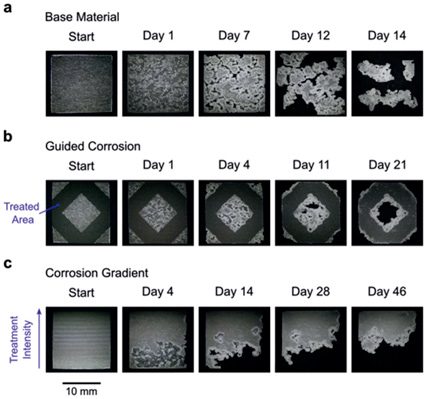
Using laser texturing we demonstrated the possibility to tailor the corrosion resistance of magnesium and alloys. In this way, we can guide corrosion. Applications like batteries, biodegradable implants or cathodic protection systems may benefit from such a controlled and tailored corrosion.

Proof of the “laser-guided corrosion control” concept

Laser texturing to produce suitable surfaces for dew harvesting

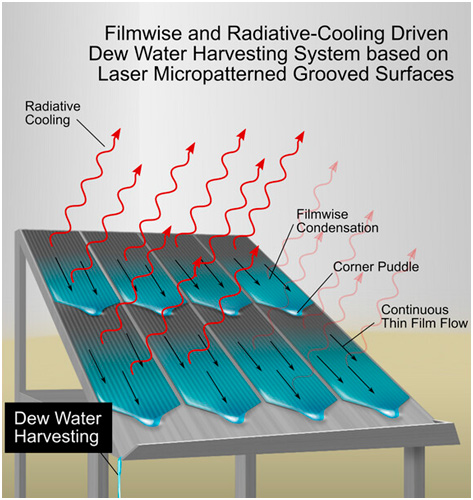
Laser textured aluminum surfaces simultaneously achieve ultra‑high infrared emissivity and superhydrophilic behavior, enabling efficient passive radiative cooling and filmwise condensation. As a result, these surfaces exhibit self‑cooling under radiative deficit conditions and significantly reduced water retention. Their robustness and scalability are demonstrated through a full-size outdoor autonomous dew harvesting system, which consistently yields a 70% increase in collected water over a state‑of‑the‑art reference material during a year‑long field study.

Autonomous water harvesting using laser textured materials

Laser microcladding

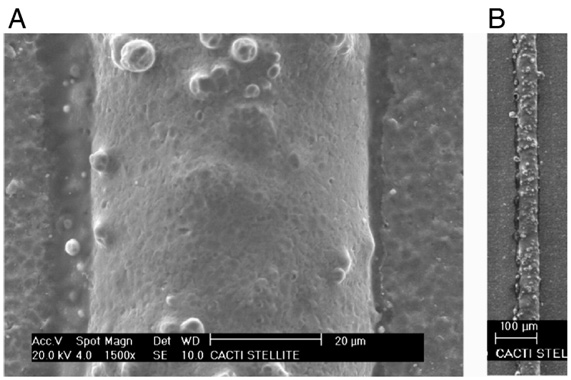
We have developed an advanced laser microcladding technique designed for next-generation micro-manufacturing. As an evolution of conventional laser cladding, this additive process offers a powerful alternative to thin-film technologies, enabling higher deposition rates and compatibility with a wide range of materials. Our approach produces metallic micro-coatings with feature sizes down to tens of microns while minimizing thermal load on sensitive substrates and preserving excellent mechanical properties. Enabled by a single-mode fiber laser and an innovative submicron powder delivery system, laser microcladding opens new opportunities in MEMS fabrication, rapid prototyping, and the repair of high-value micro-components.

Micrograph of the surface of a track produced with laser microcladding